One platform
Instead of ten services that have to be wired to one another — a single system with shared permissions and shared accounting. There is nothing to integrate: inside, it is already connected.
Any model, spend visible per employee, agents governed by an administrator and the company's shared context — in one system. It runs in our cloud, and where data must not leave the company, inside its own perimeter.
The tools arrive one at a time: a department pays for one vendor, engineering works with another vendor's keys, support runs a bot nobody remembers. Nobody holds the whole picture — and that is not a matter of discipline, it follows from there being no shared system at all.
More tools than anyone can hold in their head
Every new tool means a separate invoice, separate permissions and a separate place data can leak from. None of them knows the others exist.
There is a policy on AI spend — there is no instrument that shows it
The invoice arrives as a single number: no way to see who spent it, on what, or when. What you cannot see, you cannot manage — you can only be surprised by the total.
Agents appear on their own, outside any control
Someone spins up an agent in an outside service, puts it on a schedule — and every morning it reads something and spends money. The person leaves the company; their agent keeps working.
The company's context sits nowhere — and models cannot see it
Why this decision was taken, who objected, what had already been tried and dropped — all of it is scattered across tickets, chats and documents. Every answer has to be reassembled by walking round colleagues, and when a person leaves, the context leaves with them.
The company connects its own model providers and starts working — in our cloud right away, or inside its own perimeter if its rules demand it. Below are the three things the platform actually gets installed for.
Instead of ten services that have to be wired to one another — a single system with shared permissions and shared accounting. There is nothing to integrate: inside, it is already connected.
An employee creates the agent; the administrator sets the frame — which tools and models it may use, what its spending ceiling is, whether it runs at all. The agent sees exactly what its creator sees, and that is enforced by the engine, not by the wording of the task.
Everything the company knows is gathered in one place and stays there when a person leaves. People and agents both draw on it: a new agent does not have to be told how things work here — it already knows.
Anthropic, OpenAI, Google, xAI — or a local model on your own hardware. The company's keys, the company's rules, one place where a model is switched on and assigned to a job.
Spend by person, by model and by agent, with a weekly ceiling per person and an alert when a threshold is crossed. Chat and agent work are counted separately, so you see not only how much, but on what.
The administrator sets the ground rules agents are built on: which tools they can reach, which models they can be given, what the spending ceiling is. From there they see every agent in the company and can stop any of them; disabling an employee stops their agents too.
Connectors pull Confluence, Jira, GitLab and Slack into a single store with hybrid search and a graph of relations. Source-system permissions are honored per document: a person sees in the answer exactly what they see in Jira itself.
Web chat, Slack, Telegram, Mattermost, MCP and an external API — six entry points on a single core. People work where they already are.
The system is useful immediately as a shared door to models with transparent spend, even while the knowledge base is empty, and matures into company memory as sources are connected. There is no mode to switch: the first document loaded turns search on by itself.
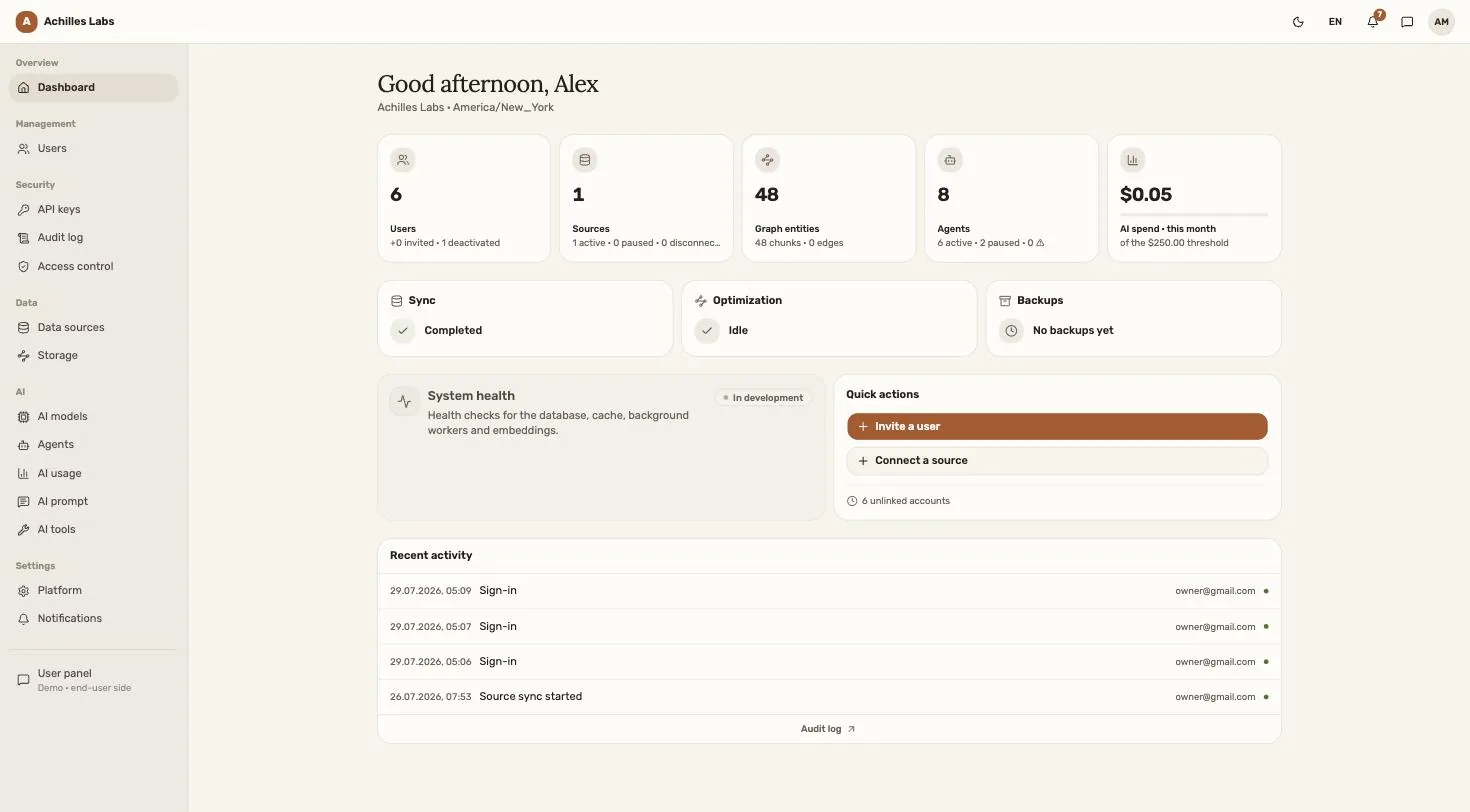
Below are screenshots from the live instance, not mockups. Access is open: the login and password are printed above, and no signup is needed.


Version one is complete and verified end to end: from pulling data out of the sources to an answer arriving in a messenger. The platform runs on a public instance you can log into right now.
The knowledge graph, the vectors and the permissions all live in one PostgreSQL — no separate graph engine, no external vector database. Hence cheap operation: one system rather than a zoo of services to keep alive. And hence a capability few can offer — the same platform moves into a client's own perimeter whole, down to a network with no internet at all.
The mid-market buys these systems rather than building them
A year ago half of them were assembled in-house; now three quarters are bought ready-made. A company of two or three hundred people has no team to glue together a model gateway, a vector store, permissions and spend accounting on its own.
The market has grown large enough to start counting money
Analysts record the shift in what is being asked: from "give us access to models" to "show the return and keep the spend under control". That is precisely the job this platform was built for.
Part of the production work is leaving the public cloud
The turn took a single year and concerns production work, not experiments. We cover both sides: an ordinary company is well served by our cloud, and those who cannot let data out get the same system inside.
For some buyers this is a question of admission, not taste
The AI Act and Data Act in Europe, MAS requirements in Singapore, data localization in Vietnam, Indonesia and India. A bank or a hospital cannot buy a solution that keeps their data in someone else's cloud — which puts them out of reach for most competitors.
The buyer is a company of one hundred to a thousand people that already runs several AI tools and has no platform team to connect them. The decision sits with the IT director: 65% of them hold a dedicated AI budget in 2026, against 36% two years earlier. A separate segment is organizations required by a regulator to keep data inside their own perimeter.
The pace of the category shows in its leader: Glean went from $200M to $300M in annual revenue in five months and is valued at $7.2B. In August 2026 it described the market's problem in the same words we do: gaps in context, rising costs and AI sprawl across the company.
The main path is a subscription to our cloud: the company brings nothing up itself and pays for each working employee. Large and regulated organizations that need the system inside their own perimeter buy an annual license.
| What we sell | Price | For whom |
|---|---|---|
| Cloud · Team | $15–19 per employee / month | Smaller companies: ready to work, nothing to deploy |
| Cloud · Business | $24–29 per employee / month | The mid-market: higher limits, every connector, support |
| Own perimeter · Enterprise | $25–150K a year | Large and regulated. The price follows company size: around $25K for a hundred employees, around $150K for a thousand. On top of that — audit, retention, an isolated perimeter, warranties and a service level agreement |
| Tokens and storage | usage-based | A pool comes with the subscription; beyond it, a transparent rate |
Price as a difference. The market median is $24 per employee per month; the closest open competitor charges $20, the Microsoft add-on $30. Meanwhile neither Glean nor Notion publishes a unit price for consumption — a buyer cannot work out their own bill in advance. We can give them that, and in this category it is rare.
Search knows what exists. The graph knows what is connected to what. Beyond that begins something nobody does today: understanding why the company ended up the way it did.
Agents you switch on instead of writing: company analytics, digests, watching over processes. The first set is the company looking at itself — where a service rests on a single person, where two teams do the same work, where documentation is missing.
Not only documents and links, but the history of decisions: who proposed, who objected, which alternatives were weighed and why they were dropped. That is what turns a knowledge base into the company's memory.
The platform already holds everything the development process rests on: tickets, code, discussions and the reasons behind past decisions. A separate offering grows naturally on top — agents carrying a task from statement to finished change, by the company's own rules. A second product on the same foundation, with a price of its own.
A personal assistant holding the company's full context notices a risk by itself, surfaces the relevant past experience and warns a person before they run into the problem. Beyond that — agents that carry out whole tasks on company knowledge and by company rules.
What is missing is proof of demand: live deployments that pay, and a team to serve them. We are looking for a partner — a fund or a company — to back this stretch of the road and help walk it. The amount and the terms are a separate conversation.
Not pilots for show, but companies that keep the system in daily work. They, and not the popularity of a repository, are what shows the product is needed.
The product is ready, but a product is not a company. We need someone to take on go-to-market, and a small team to sustain the pace of supporting clients.
The price range is derived from market benchmarks but untested in negotiation. It needs to meet real buyers and be corrected by what comes back.
Southeast Asia and Europe look like the natural entry: there, data residency requirements make working inside your own perimeter not an advantage but a condition of admission — and they cut most competitors out.
The instance runs continuously, on a live knowledge base. No signup — create an agent, ask a question against company knowledge, and see what it cost.